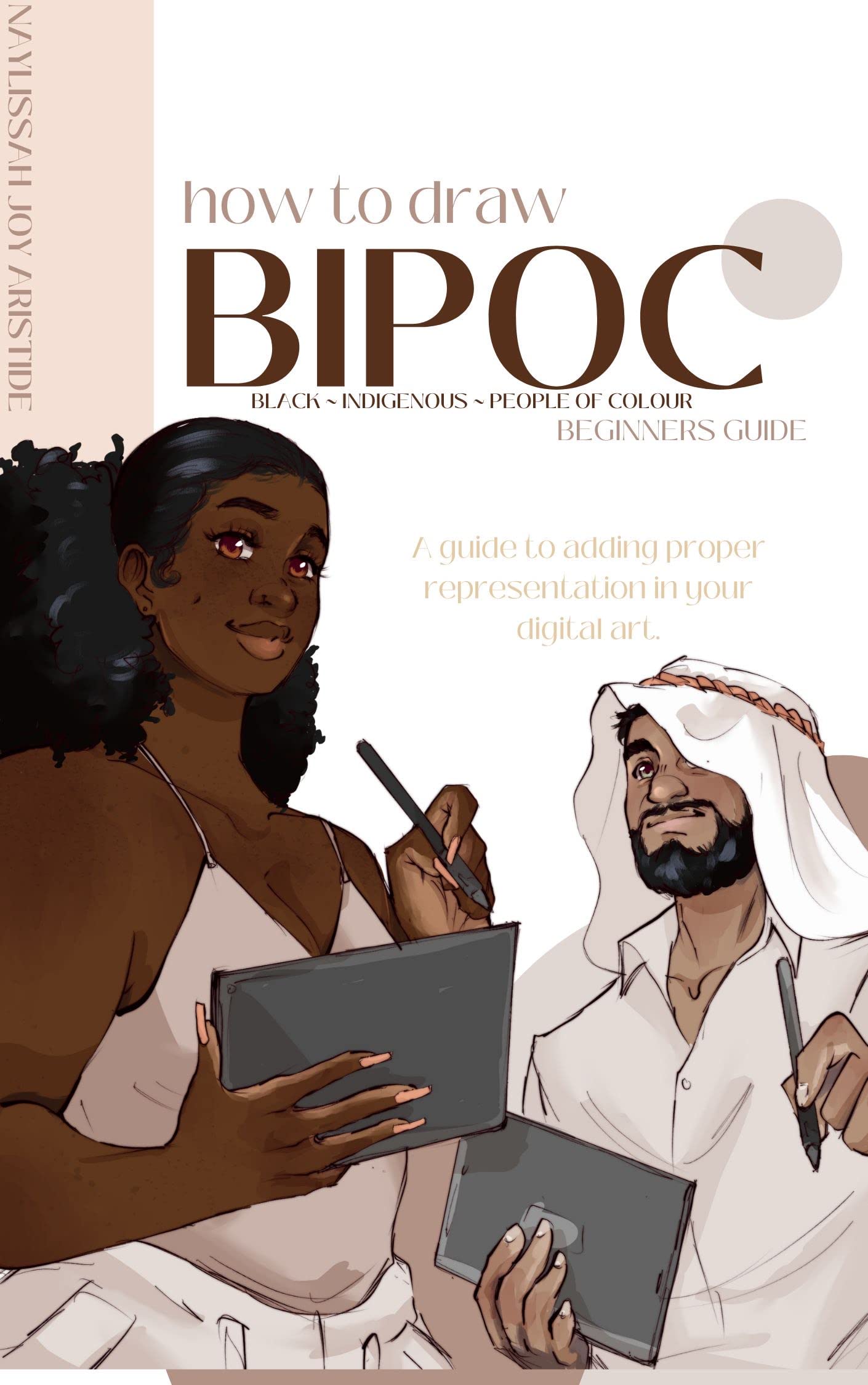
How To Draw BIPOC: A guide to adding proper representation in your digital art. by Naylissah Joy Aaristide
BIPOC means Black Indigenous People of Colour
I am privileged to live in a country that is learning to accept people from all over the world. I have been challenged in my thinking as I grow older however I am able to relate and respect young talented people of all backgrounds. The following is a question and answer response between me, a 70 year old white lady with limited artistic talent, and the artist and young creator.
How a 70 year old white lady interviews a young Bipoc artist with respect and interest.
Question and answer format between Naylissah Joy Aaristide creator of “ Beginners Guide: a guide to proper representation in your digital art”
and Hilda Young interviewer
By Hilda Young
I have enjoyed learning about the different writers and illustrators in the Ottawa region who Nicole has introduced me to. Each book has been a learning experience for me. Perhaps the most challenging has been the art instruction book as it is out of my comfort zone. I took art classes back in the dark ages about 30 years ago and a Corel draw class but did not practice.
- How long did it take you to create the drawings?
Answer: For this book specifically it took me 3-4 days. They were all short and small drawings so they did not take as much time as full illustrations.
2.Did you have a mentor?
Answer: No, I have no mentor, I am self taught.
3.What digital program do you recommend?
Answer: There are many that I recommend especially to beginner artists, the one I used is Clip Studio Paint, however that program is a little pricey and better when paired with a computer, if you use a tablet to draw I fully recommend Procreate, and if you’re looking for a free option I recommend Ibispaint.
4.How long have you been drawing?
Answer: I have been drawing since I was eleven years old and now I am 18 so about 7 years.
5. Do you only use digital programs now?
Answer: No! I believe that all artists should still be in tune with their roots ( the simple pencil and paper). I have plenty of sketchbooks that I still draw in till this day!
6. Is this self published?
Answer: Yes! It was actually I did with my family, we all decided to write a book with a subject we are passionate about. Once we all completed the books we just went ahead and published them!
7. How long did it take from conception of idea to publication?
Answer: Since the whole thing was a challenge me and my family wanted to do, it actually took us all 7 days. That was all the time we had!
8. What made you decide to write the book in this format?
Answer: Funnily enough it wasn’t fully my decision, my father had recommended this format and I simply went with it. He seemed to know what he was doing at the time so I followed what he told me.
9. You ask the reader to do a lot of research in the more challenging aspects of drawing or painting someone of Bipoc. Have you had any discussion with readers about the amount of work that is necessary to do the proper research?
Answer: There have been a few people who have reached out to me with questions similar to this. Most of the time, regardless of your artistic levels, I recommend to never stop researching and using references. If there is anything you are unsure about, just search it up, we are in an age where the answers are just at your fingertips so we are lucky that it isn’t exactly a ‘ hard’ thing to do.
10: Are you willing to be a resource for artists and graphic designers who are attempting to create Bipoc people?
Answer: Absolutely, if there is any way I can helpI will. On my Tiktok I often post tutorials and videos with more in depth explanations on how to draw BIPOC and why it is important to do so..
11. Have you had any feedback from the art community in general?
Answer: For the most part I have had a positive response, although many artists have told me that they wished it was longer and had more tutorials. I agree with them, which is why I am currently working on an expanded version of this book.
12. Are you willing to give classes based on your book to teenagers or others who want to learn how to shade etc?
Answer: Absolutely! I have only done one class before, however I do love teaching to the best of my abilities.
13. Can these rules be transferred to those who use crayons and pencils to shade in the differences?
Answer: Yes! However in terms of the colour section, it has more tips for digital artists, but in terms of the simple drawings, they are tips for just abut any medium out there.
I looked at Naylissah’s media pages and am impressed with her vision. As I live in a community which is attempting to acknowledge all points of view I found her book and attitude refreshing. My title was tongue in cheek as I realise that with her maturity she relates to all ages. At the end of the short on my part questions I gave Naylisssah some links of a group in Renfrew county she may want to connect with.
My comments follow:
Would you consider giving a lesson by zoom or in person in Lanark or Renfrew county? There are several groups in this area who are attempting to showcase the BIPOC community. Local Immigration partnership is having various work shops on developing skills from other countries. If you are interested contact: localimmigrationPartnership@algonquincollege.com
I also suggested she check liplanarkrenfrew.ca Also check out StudioDreamsare
You idea of providing simple instructions to help those of us who are not Bipoc acknowledge and respect the cultural differences of us all . I think you are just starting on your educational journey


 Hilda Frances Young: Community connector
Leave a reply to Matthew Lucas Cancel reply